
Pandemic-hit country’s aviation sector struggle to stay afloat
Aviation News Desk:
The pandemic-hit aviation sector of the country is still struggling to find its wings back as meeting stringent safety conditions makes it very hard for the Bangladeshi operators to enter the gradually reopening airspace. Making sure that passengers are certified Covid-19 free to be eligible to fly is an additional burden on them.
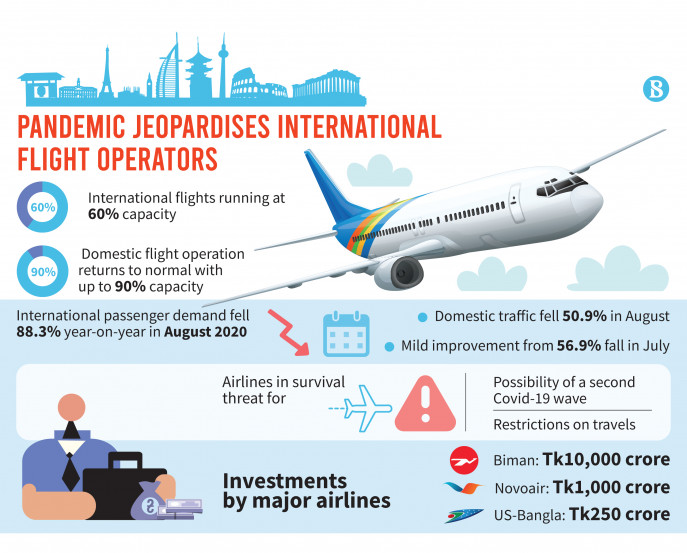
The pandemic devastated the Bangladeshi aviation sector just when the national flag carrier invested Tk10,000 crore and the other local aviators another Tk500 crore to expand their operations.
But with paltry income and a bleak international aviation forecast for the next three years, the industry is now facing tremendous pressures of loan repayment and paying their staff.
The airlines now seek policy support and whole-hearted support from aviation-related authorities, including the customs department, to minimise their operational losses, speakers said at a webinar organised by The Business Standard.
They also suggested that the government put all-out efforts for credible Covid-19 testing and certification for all outbound passengers to ensure that foreign airports feel confident with passengers coming from Bangladesh.
Even though inbound and outbound travels restarted in June, international flights are being operated at 40% capacity loss due to various restrictions imposed on air travels by different countries, said Md Mokabbir Hossain, managing director of Biman Bangladesh Airlines.
Air operators have to run flights keeping two rows of seats empty in compliance with the instructions of the Civil Aviation Authority of Bangladesh (Caab). Moreover, different countries have taken quarantine measures and set many other conditions that include having a Covid-19 test certificate.
A lack of passenger demand is another challenge, he said.
“Biman has been operating flights in spite of losses because keeping its fleet grounded would be even more lossmaking,” he said.
The other two local private airlines, US-Bangla and Novoair, are in serious difficulty as well as they continue operating flights despite losses since the reopening of the airspace in June.
The aviation industry started to suffer from the pandemic fallout from February this year and it is still running at 50% capacity loss, said Mofizur Rahman, managing director of Novoair.
Citing the case of increased transport fares in other sectors while airfare remained unchanged even during the present crisis situation, he said, “As a result, air operators are still grappling with losses.”
Large airline companies around the world got financial support from the government to pay salaries, but the local airlines in Bangladesh did not get such support, he said.
The Novoair managing director said the aviation industry now needs policy supports like reduction of fuel price, revising down of aviation charges and tax to continue the business.
He said airline operators will have to come up with proper planning to expand the domestic market and develop internal tourism for the sake of the survival of the aviation business.
US-Bangla, the largest private carrier in the country that was planning to make more investment to increase inter-connectivity, backtracked on its business expansion plan in the wake of the coronavirus outbreak.
The pandemic has setback the airline industry for at least two years, said Sikder Mezbahuddin Ahmed, chief executive officer of US-Bangla.
“Now we are making a survival plan,” he said.
The main challenge for the air operators is to boost the confidence of travelers by ensuring safety measures as there is a fear of a second wave of the infection, he observed.
In the domestic routes, US-Bangla has already seen improvement in passenger load factor by up to 90% by working on recovering passenger confidence, he said.
In the case of international flights, the government needs to ensure proper Covid-19 certification as required by the destination countries, he said.
“If the government can ensure proper testing of air passengers, it will help air operators get entry permission to more countries. This will boost the aviation business,” he asserted.
Meanwhile, the International Air Transport Association (IATA), recently downgraded its traffic forecast for 2020. The association now expects full-year 2020 traffic to be down 66% compared to 2019. The previous estimate was for a 63% decline.
In August, international passenger demand plummeted 88.3% compared to August 2019, witnessing a mild improvement from a 91.8% decline recorded in July, according to the IATA.
Domestic markets continued to outperform international markets in terms of recovery, although most remained substantially down than a year ago.
Domestic traffic fell 50.9% in August. This was a mild improvement compared to a 56.9% decline in July. Domestic capacity fell 34.5% and load factor dropped 21.5 percentage points to 64.2%, according to IATA.
Source: TBS

